







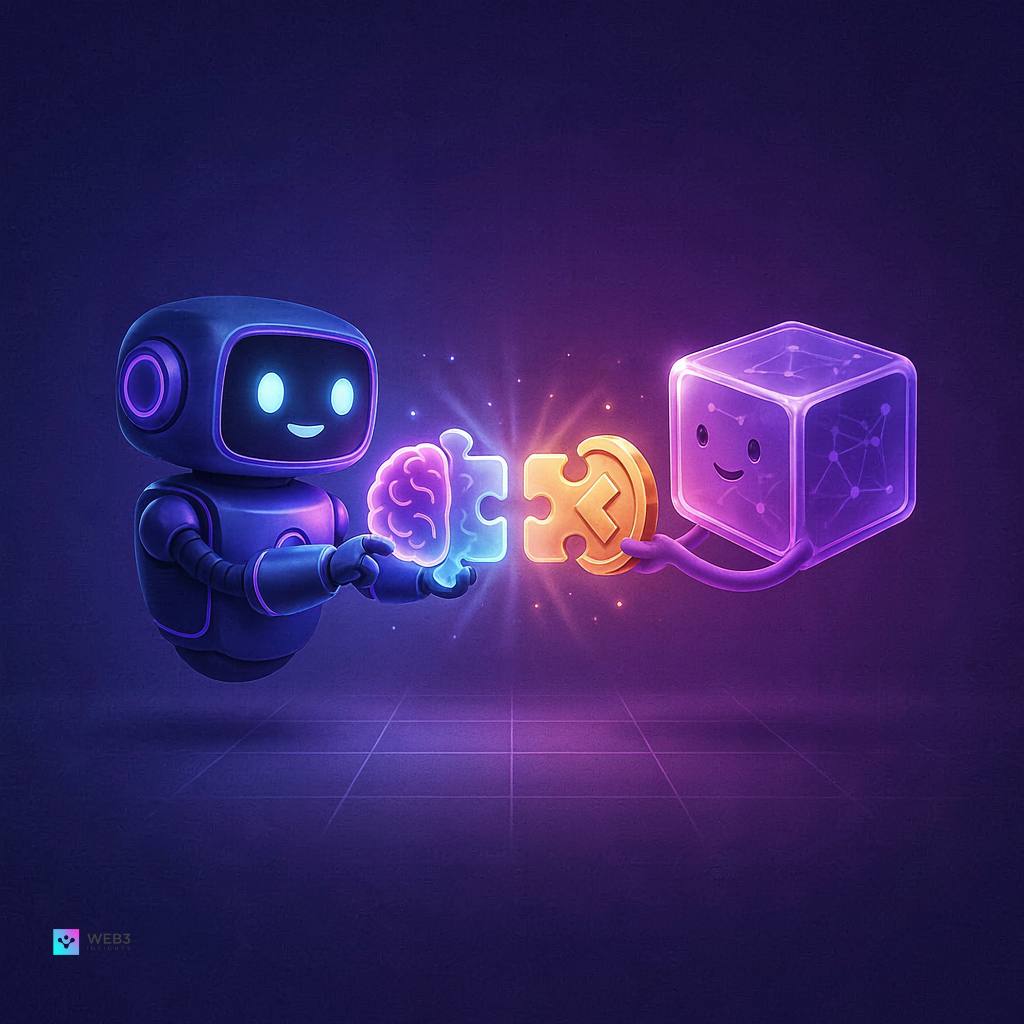
AI and Web3 are starting to look less like two separate technology trends and more like pieces of the same puzzle.
Web3 gave software something it didn’t really have before: programmable ownership and money.
AI gave software something else: the ability to understand information, make decisions, and perform increasingly complex tasks.
Put those together and things get interesting.
Imagine an AI agent that doesn’t just tell you which DeFi opportunity it’s watching.
It can actually interact with the protocol.
Or an AI system that doesn’t just analyze blockchain transactions.
It can continuously monitor them, identify suspicious activity, and surface the important signals for a human investigator.
Or imagine software that can earn money, pay for computing resources, and transact with other software without a person approving every single payment.
That isn’t science fiction anymore.
Ethereum’s current AI-agent ecosystem already includes systems that can interact with blockchain networks, control wallets, analyze markets, and execute transactions. Meanwhile, blockchain-intelligence companies are deploying agents for automated on-chain monitoring and investigations.
But the bigger question is:
What does all of this mean for the next version of Web3?
Web3 Is Moving From Apps to Agents
The first generation of Web3 was largely built around applications.
You opened a wallet.
Connected to a decentralized exchange.
Signed a transaction.
Interacted with a smart contract.
Then did it all again.
It worked, but the experience was still very human-driven.
AI agents introduce a different possibility.
Instead of you manually interacting with every application, an agent could potentially do some of the work for you.
You could give it a goal.
It could gather information, decide which tools it needs, and execute a series of actions within the permissions you’ve given it.
That’s a major shift.
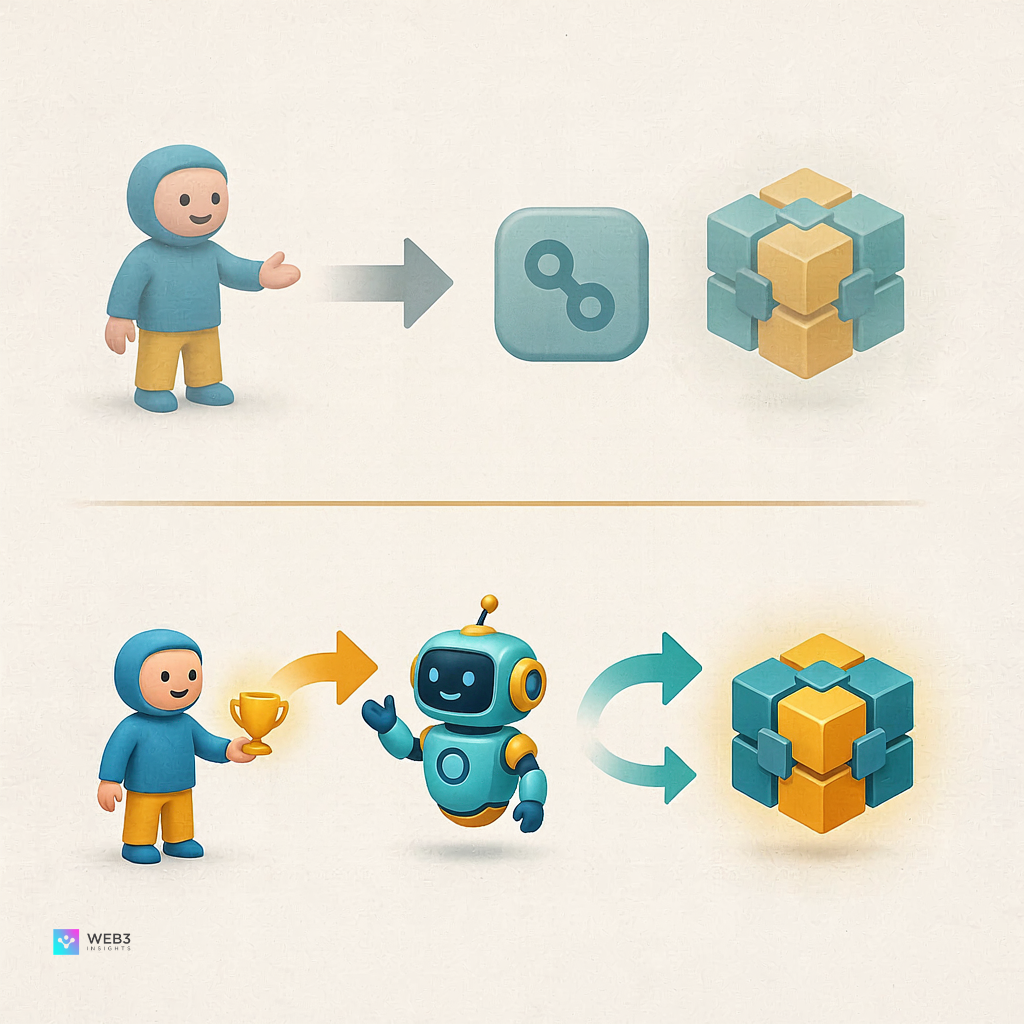
We’re moving from:
Human → App → Blockchain
toward something closer to:
Human → AI Agent → Web3 Infrastructure
And the agent becomes the interface.
A 2026 study of autonomous AI agents in DeFi identified hundreds of agents operating across areas including trading, governance, community activity, and other applications.
The technology is still early, but the direction is becoming harder to ignore.
AI Could Make Web3 Much Easier to Use
Let’s be honest.
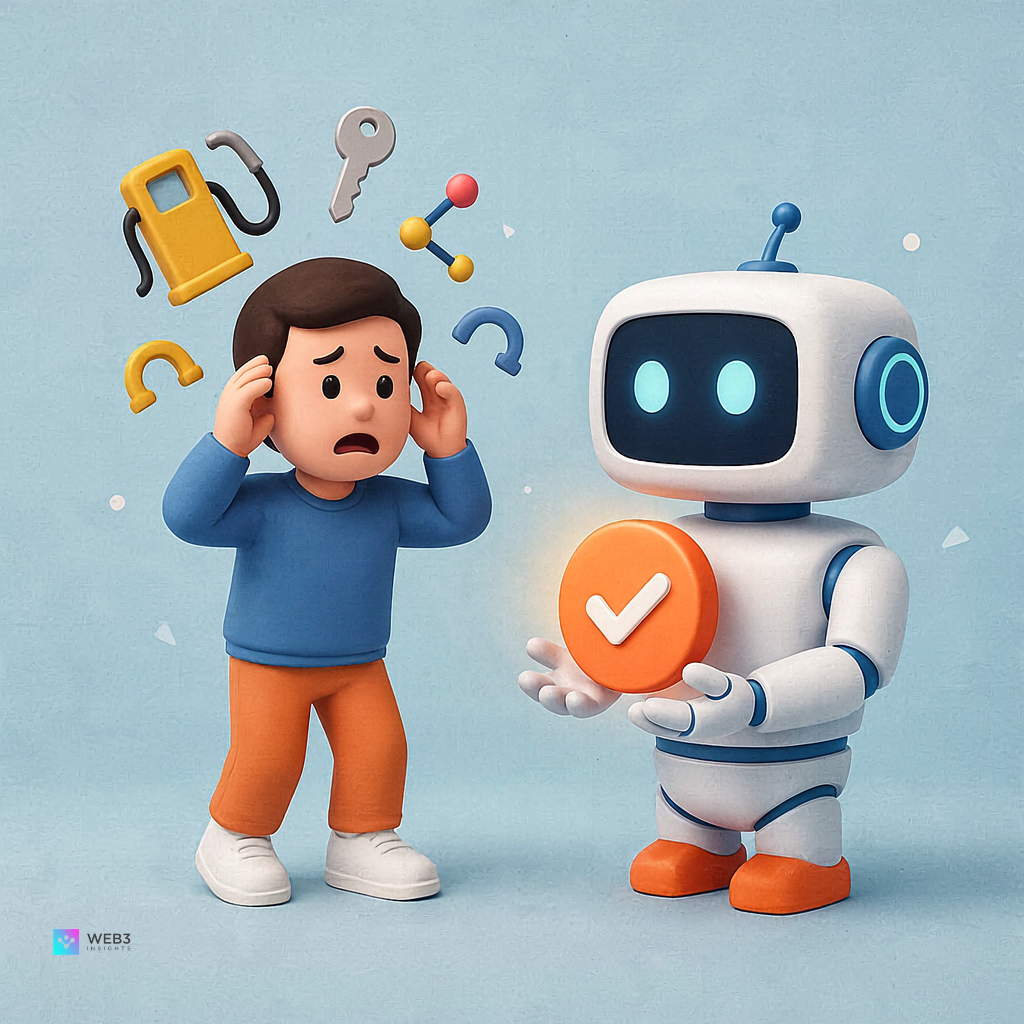
Web3 hasn’t always been beginner-friendly.
Gas fees.
Wallet addresses.
Networks.
Bridges.
Approvals.
Slippage.
Private keys.
Smart contracts.
For someone new to crypto, that’s a lot to understand before they’ve even made their first transaction.
AI could simplify much of that experience.
Instead of manually figuring out which network to use or which DeFi protocol fits a particular strategy, users could interact with an AI assistant in plain language.
Something like:
“I want to move some USDC to this network and keep transaction fees low.”
The agent could potentially figure out the required steps and present the user with an action to approve.
The technology doesn’t eliminate the underlying complexity.
It simply hides some of it.
And that’s important.
The internet became easier to use when people stopped needing to understand how servers and networking worked every time they opened a website.
Web3 could follow a similar path.
The blockchain stays underneath.
The AI becomes the interface.
AI Agents Could Create a Machine Economy

This might be the most interesting part.
Humans aren’t the only ones that can use money.
Software increasingly needs to pay for things too.
An AI agent might need computing power.
It might need access to a data API, to pay another agent for a service.
It could potentially earn revenue by providing a service of its own.
Traditional financial infrastructure wasn’t designed around millions of autonomous software programs making tiny payments to one another.
Crypto is much better suited to that idea.
Blockchain networks can provide programmable payments, while stablecoins can give agents access to digital money without requiring a human to manually authorize every small transaction.
The emerging on-chain agent economy is already showing signs of this direction. A 2026 State of Agents report currently tracks more than 140 million machine-to-machine transactions and reports that USDC accounts for 98.6% of the payment activity it measures.
Those figures shouldn’t be interpreted as proof that a fully autonomous machine economy has arrived.
But they show something important:
Machines are starting to transact with machines.
That’s a very different internet from the one we’re used to.
What This Means for Traders and the Future of Web3

For traders, this convergence could change the way market research and execution work.
Instead of manually monitoring ten dashboards, an AI agent could potentially watch the market continuously.
It could track price action.
Monitor on-chain activity.
Watch liquidity.
Analyze sentiment.
Look for unusual transactions.
Then bring the important information to you; or, within clearly defined limits, take an action.
We’re already seeing this idea applied outside pure trading.
Chainalysis launched blockchain-intelligence agents in 2026 that can monitor on-chain activity, conduct automated analysis, and surface leads to human investigators.
That gives us a glimpse of where Web3 could be heading.
The blockchain provides the activity.
AI interprets it.
Agents act on it.
Humans define the boundaries.
And that’s probably the most realistic vision of the next generation of Web3, not a world where humans disappear from the loop, but one where software handles more of the repetitive work.
There is still a huge amount to figure out.
Security.
Privacy.
Agent identity.
Governance.
Accountability.
And perhaps most importantly, how much autonomy should we actually give machines?
Recent research continues to highlight opacity, misalignment, and concentration of control as significant risks as AI agents become more autonomous in decentralized environments.
So the future isn’t simply about making agents more powerful.
It’s about making them more controllable and trustworthy too.
Trader’s Take
The next generation of Web3 probably won’t look exactly like the Web3 we know today.
Users may interact less with individual protocols and more with AI agents that navigate those protocols on their behalf.
Instead of :
- manually checking every market signal, an agent could monitor them.
- manually executing every transaction, an agent could handle approved actions.
- software simply sitting on a server, autonomous agents could increasingly have wallets, identities, payment capabilities, and on-chain histories.
That’s where AI and blockchain become genuinely interesting together.
AI brings the intelligence and autonomy.
Blockchain brings the ownership, payments, execution, and transparency.
Neither technology solves everything on its own.
But together, they could make Web3 significantly more useful, and much more automated.
The real question isn’t whether AI will become part of Web3.
It’s how much of Web3 we’ll eventually let AI run.