





How AI is changing crypto investing goes far beyond chatbots answering questions about Bitcoin.
AI is increasingly being used across the entire investment process: researching assets, analyzing market data, constructing portfolios, monitoring risk, automating strategies, and even executing transactions.
That matters because crypto is an unusually information-heavy market.
Thousands of assets trade around the clock.
New narratives appear constantly.
On-chain activity changes by the minute.
And the amount of information an investor could potentially analyze is far beyond what one person can realistically process.
AI gives investors a way to deal with that complexity.
But there’s an important distinction.
AI isn’t automatically making investors better simply because it can process more information.
The real change is that more of the investment process can now be automated, personalized, and continuously monitored.
And we’re only beginning to see what that means.
1. AI Is Changing How Investors Research Crypto
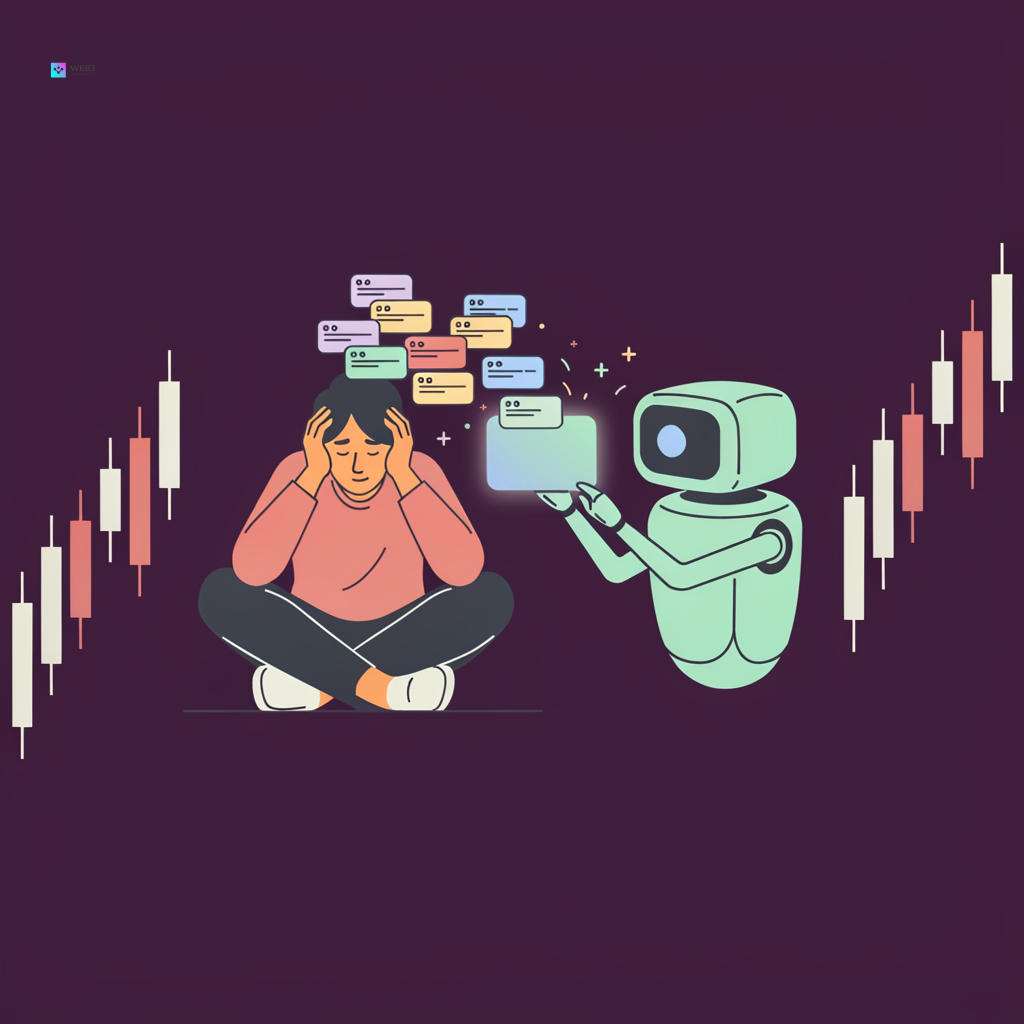
Crypto research used to involve opening dozens of tabs.
You’d check price charts, project websites, tokenomics, news, social media, on-chain data, exchange activity and maybe a few research reports.
Then you’d try to put everything together.
AI can compress much of that process.
An investor can ask an AI system to:
- Summarize a project’s fundamentals
- Compare competing protocols
- Analyze tokenomics
- Track recent developments
- Identify important risks
- Compare market narratives
- Examine on-chain activity
- Summarize research papers
- Challenge an investment thesis
That doesn’t mean the AI’s answer should automatically be trusted.
In fact, recent research on AI in investment markets emphasizes that technical capability isn’t the same thing as demonstrated profitability. A September 2026 review covering AI applications across equities and crypto found meaningful progress in prediction, text processing, portfolio design and workflow integration, but much thinner evidence for durable net performance after costs and other real-world constraints.
That’s a useful reality check.
The advantage isn’t necessarily:
“AI knows which coin will go up.”
It’s:
“AI can help me investigate an investment opportunity much faster.”
That is a much more realistic use case.
2. AI Is Making Investing More Personalized

Traditional investment products often put investors into predefined categories.
Conservative.
Balanced.
Aggressive.
But two investors who both describe themselves as “moderate risk” can have completely different objectives.
One might want long-term capital growth.
Another might want income.
Another might be willing to tolerate large drawdowns because they have a 15-year horizon.
AI can potentially make portfolio construction more personalized.
Instead of selecting a generic portfolio, an investor could define objectives such as:
“I want long-term crypto exposure, Bitcoin as my core holding, limited exposure to small-cap assets, and a maximum portfolio drawdown that I’m uncomfortable exceeding.”
An AI system can then evaluate potential allocations against those constraints.
That doesn’t guarantee a better portfolio.
But it changes the process from:
“Which portfolio should I buy?”
to:
“What portfolio best matches my objectives and constraints?”
This is already becoming an active research area.
A 2026 survey of 119 publications on digital-asset portfolio optimization found growing research around machine learning, deep learning, reinforcement learning and other computational approaches to portfolio construction.
The important shift is that AI isn’t only being used to forecast individual assets.
It’s increasingly being applied to the portfolio itself.
3. AI Is Moving From Analysis to Automation

This might be the biggest change.
For a long time, AI mostly gave investors information.
Now we’re moving toward systems that can take action.
Consider the difference.
Traditional AI assistant:
“Bitcoin’s allocation has increased from 40% to 58% of your portfolio.”
Automated investing system:
“Bitcoin has exceeded your 50% allocation threshold. I’ve prepared a rebalance.”
More autonomous system:
“Your portfolio has exceeded its risk limits. The system has reduced the relevant positions according to your predefined rules.”
That progression is important.
AI is moving from answering questions to participating in workflows.
Research published in September 2026 provides a good example. Researchers developed a multi-agent AI system for crypto portfolio construction that autonomously constructs and evaluates allocations and compares static versus rolling-window optimization strategies. In their specific research setting, the dynamic approach produced stronger risk-adjusted results both in-sample and out-of-sample.
That’s not proof that autonomous AI investing will beat the market.
But it demonstrates where the technology is heading.
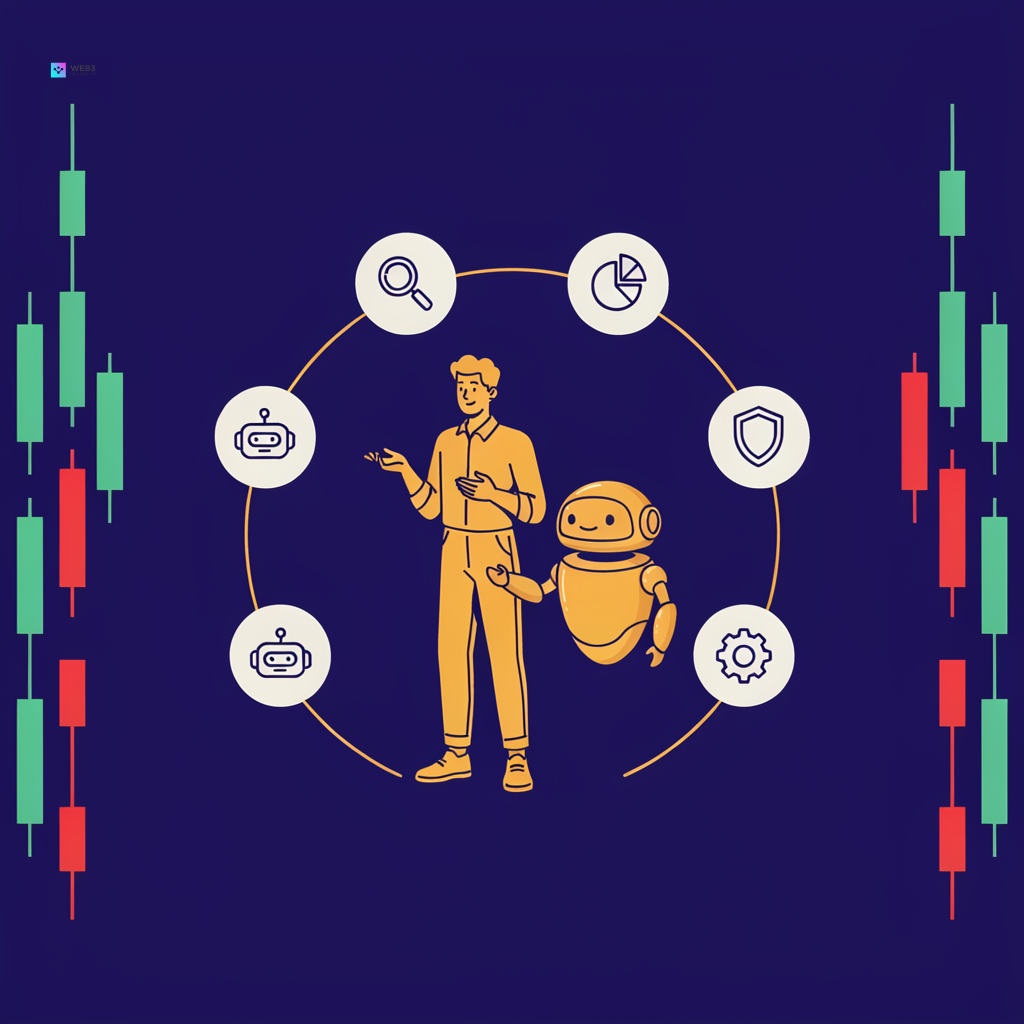
The investor increasingly becomes the person who defines:
the objective + the constraints + the authority
while the AI handles more of the ongoing process.
4. AI Is Changing the Role of the Investor
This may be the most interesting part.
If AI can research assets, monitor markets, construct portfolios and automate rebalancing, what does the investor actually do?
The answer isn’t “nothing.”
The investor’s role changes;
- Instead of spending most of your time collecting information, you can spend more time deciding what information matters.
- Instead of manually monitoring every position, you can define risk limits.
- Instead of checking the portfolio every few hours, you can design rules for when you actually need to intervene.
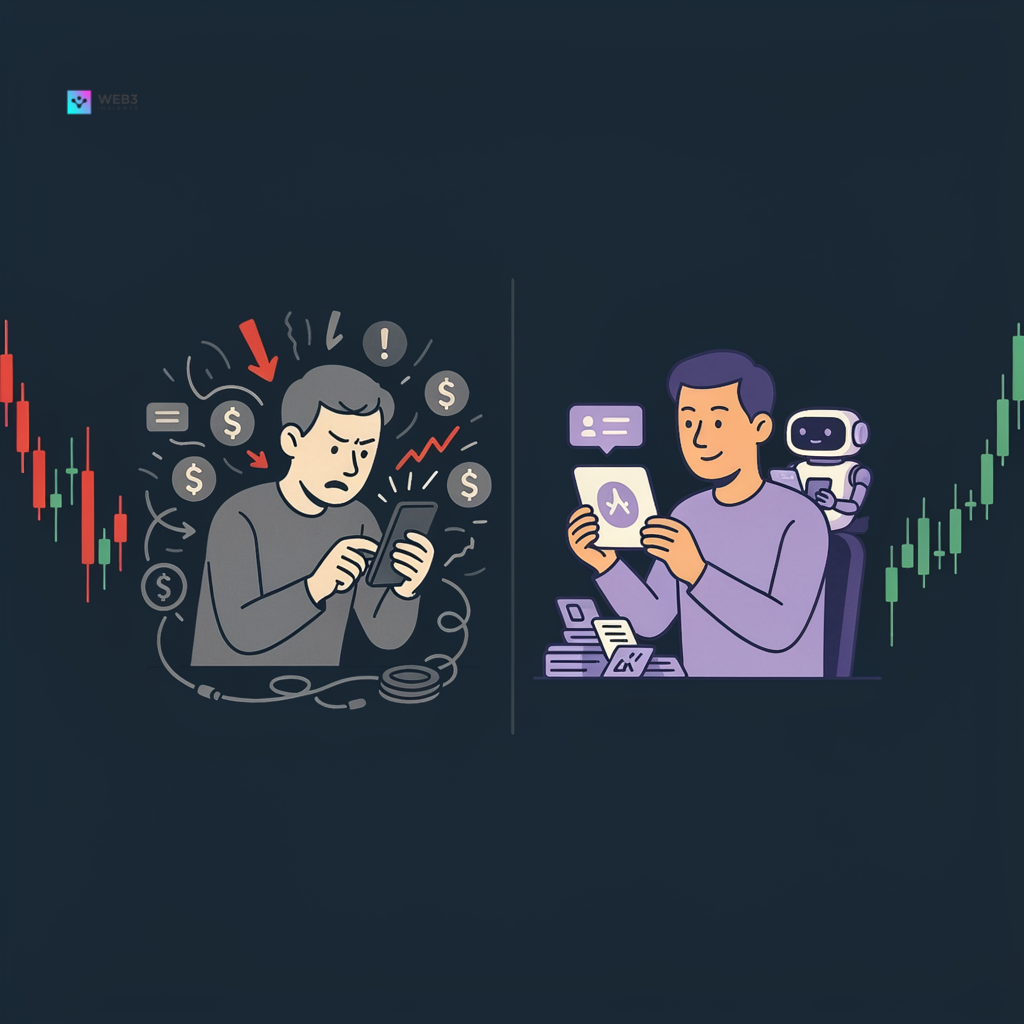
Think about the difference between these two investors.
Investor A
Spends hours scrolling through crypto Twitter.
Checks charts constantly.
Chases whatever narrative is trending.
Changes positions emotionally.
Investor B
Uses AI to monitor markets and summarize relevant developments.
Has a defined portfolio structure.
Uses AI to stress-test the portfolio.
Receives alerts when risk or allocation thresholds are breached.
Reviews the important decisions personally.
AI doesn’t replace Investor B.
It gives Investor B leverage.
That’s probably the more realistic future of AI investing.
5. AI Agents Could Become the Next Investing Interface

The biggest change may still be ahead.
AI agents are beginning to move beyond generating information and toward performing financial tasks.
This is particularly interesting in crypto because blockchains are programmable financial networks.
An AI agent can potentially interact with wallets, smart contracts, exchanges, data providers and other blockchain applications.
Fidelity Digital Assets wrote in August 2026 that AI agents could become a new class of blockchain users capable of transacting continuously and interacting directly with programmable financial services. It also highlighted agentic capital deployed through trading, lending and portfolio management as a potentially important source of economic activity.
That opens up a completely different vision of investing.
Imagine telling an AI agent:
“Maintain a diversified crypto portfolio. Keep Bitcoin as the core allocation. Don’t let any individual altcoin exceed 5%. Rebalance when allocations drift by more than 4%. Never use leverage. If portfolio drawdown exceeds 15%, stop new purchases and alert me.”
The AI isn’t simply giving you an investment opinion.
It’s managing a set of rules.
And that’s a very different relationship between investor and software.
But there’s a major catch.
The more authority you give an AI system, the more important governance becomes.
Who controls the wallet?
What happens if the model makes a mistake?
What data is it using?
Can it execute trades outside your intended limits?
What happens during a market crash?
Can you shut it down immediately?
These aren’t theoretical questions anymore.
They’re part of the architecture of AI-powered investing.
Trader’s Take
AI is changing crypto investing in a much bigger way than simply giving investors another tool for predicting prices.
It’s changing the workflow.
Research can become faster.
Portfolio construction can become more personalized.
Risk can be monitored continuously.
Rebalancing can become automated.
And eventually, AI agents may be able to manage increasingly complex investment tasks with limited human intervention.
But there’s an important lesson here.
More automation doesn’t automatically mean better investing.
A system can process information faster and still use bad information.
A model can build an impressive portfolio and still fail when market conditions change.
An agent can execute perfectly and still execute a terrible strategy.
The investor therefore doesn’t disappear.
The investor becomes the person responsible for designing the system: defining objectives, setting boundaries, choosing how much authority AI receives, and knowing when human judgment needs to take over.
That’s probably the real transformation.
The future isn’t necessarily AI investing instead of human investing.
It’s increasingly human investors using AI to operate at a scale and speed that wasn’t previously possible.